
Postpartum depression affects up to 20% of new mothers, creating overwhelming feelings of sadness, anxiety, and exhaustion that interfere with daily life.
Cognitive behavioral therapy for postpartum depression offers proven techniques to break negative thought cycles and rebuild emotional wellness. We at Sapphire Psychiatric Medical Group have seen how CBT empowers new mothers to regain control over their mental health through practical, evidence-based strategies.
This guide shows you how to apply CBT methods in your daily routine as a new parent.
What Makes CBT Work for Postpartum Depression
Postpartum depression strikes approximately 17% of women worldwide according to recent global data, but the symptoms extend far beyond typical sadness. New mothers experience persistent feelings of worthlessness, overwhelming anxiety about their baby’s safety, difficulty bonding with their child, and intrusive thoughts about harm. Sleep disruption compounds these symptoms and creates a cycle where exhaustion fuels negative thought patterns. Early intervention is absolutely essential for addressing this condition effectively.

CBT Targets the Root of Negative Thoughts
Cognitive behavioral therapy works when it identifies specific thought distortions that fuel postpartum depression. New mothers often engage in all-or-nothing thoughts, catastrophize about their parenting abilities, or personalize every baby’s cry as evidence of their failure. CBT teaches women to recognize these automatic thoughts and replace them with balanced, realistic perspectives. Research shows that those who participated in CBT showed substantial improvement in depressive symptoms. The National Institute for Health and Care Excellence recommends CBT as first-line treatment for mild to moderate postpartum depression because it addresses both thoughts and behaviors simultaneously.
Evidence Shows CBT Delivers Results That Last
Research demonstrates that CBT interventions that last 9 weeks or longer produce the most significant improvements in postpartum depression symptoms. Professional guidance during therapy sessions proves more effective than self-directed approaches, with structured feedback and task assignments that play vital roles in recovery. CBT enhances communication between brain regions involved in emotional processing and specifically increases activity in the prefrontal cortex while it reduces overactivity in the amygdala. This neurological change leads to better emotional control that persists long after treatment ends. Online CBT platforms that use websites or video calls significantly outperform mobile applications and make psychiatry services more accessible for new mothers who cannot attend in-person sessions.
How CBT Techniques Transform Daily Life
The practical nature of CBT makes it particularly effective for new mothers who need immediate tools to manage their symptoms. Thought tracking helps women identify patterns in their negative thoughts, while cognitive restructuring teaches them to challenge these distortions with evidence-based alternatives. Behavioral activation encourages mothers to schedule pleasant activities even when they feel unmotivated, which breaks the cycle of withdrawal and isolation. These techniques work together to create measurable changes in both mood and behavior within weeks of consistent practice.
How Do You Apply CBT Techniques Daily
The most effective CBT techniques for postpartum depression focus on three practical approaches that new mothers can implement immediately. Thought tracking forms the foundation where you write down negative thoughts as they occur, note the trigger, the specific thought, and your emotional response. Research shows that mothers who track their thoughts for just one week identify patterns they never noticed before.
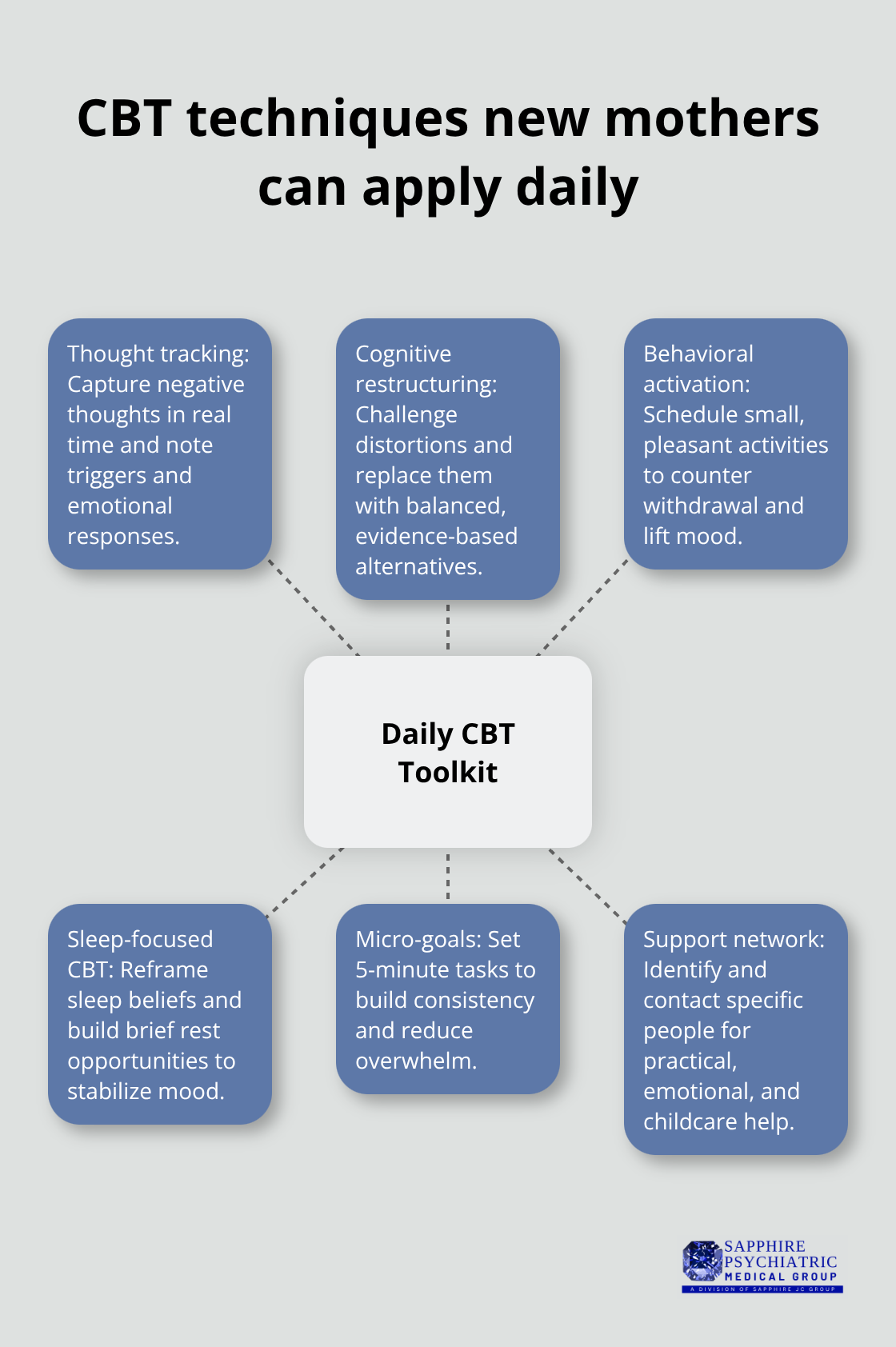
Once you recognize thoughts like “I’m a terrible mother” or “My baby would be better without me,” you can challenge them with evidence-based questions. Ask yourself what proof supports this thought, what you would tell a friend who had the same thought, and what a more balanced perspective might look like. The American Psychological Association confirms that this cognitive restructuring reduces depressive symptoms within 8 to 16 therapy sessions.
Breaking Negative Thought Cycles
New mothers experience predictable thought distortions that CBT specifically targets. All-or-nothing thoughts appear when you believe one difficult day makes you a complete failure as a parent. Catastrophic thoughts happen when you imagine worst-case scenarios about your baby’s health or development based on minor concerns. Personal blame occurs when you blame yourself for your baby’s cries or fussiness. Combat these patterns when you question the evidence behind each thought and generate three alternative explanations for any situation. Write these challenges down because depression affects memory and you need concrete reminders of balanced thoughts.
Daily Activity Plans That Support Recovery
Behavioral activation requires you to schedule one pleasant activity daily, even when motivation feels nonexistent. Studies demonstrate that mothers who engage in 20 minutes of enjoyable activities show measurable mood improvements within two weeks. Start with simple actions like a warm shower, a phone call to a friend, or a step outside for fresh air. Activity plans work because depression convinces you that nothing will feel good, but planned activities break this cycle. Sleep management through CBT methods proves particularly powerful since 38.2% of pregnant individuals experience insomnia that increases postpartum depression risk (creating a direct link between poor sleep and worsened symptoms).
Structure That Adapts to Newborn Life
Activity plans must account for the unpredictable nature of life with a newborn while they still provide structure that supports mental health. Plan activities in 15-minute blocks rather than hour-long commitments since babies require frequent attention. Include self-care activities like showers, nutritious meals, or brief walks as essential tasks rather than optional luxuries. Research indicates that mothers who maintain basic self-care routines experience fewer depressive episodes. Create backup plans for days when your original schedule falls apart because flexibility prevents the all-or-nothing thoughts that derail recovery progress.
These daily CBT applications create the foundation for deeper therapeutic work, but they require consistent practice and often benefit from professional guidance to maximize their effectiveness.
How Do You Make CBT Work With Newborn Chaos
New mothers need CBT strategies that work within the unpredictable reality of caring for a newborn, not theoretical approaches that ignore sleep deprivation and constant interruptions. Set micro-goals that take 5 minutes or less because longer commitments lead to failure and reinforce negative self-talk when you cannot complete them. Instead of planning to exercise for 30 minutes, commit to walking to your mailbox or doing three stretches while your baby sleeps. Research shows that mothers who set achievable daily goals experience 40% fewer feelings of inadequacy compared to those who maintain pre-baby expectations.
Create Specific and Measurable Daily Targets
Write down three specific, measurable goals each week such as showering every other day, eating one nutritious meal daily, or calling one supportive person. These concrete targets prevent the vague resolutions that depression uses to convince you that nothing matters. Track your progress with simple checkmarks rather than elaborate systems that require energy you don’t have. Studies demonstrate that mothers who document small wins build momentum toward larger recovery goals (even when those wins seem insignificant to others).

Build Your Communication Network Before You Need It
Support systems require deliberate construction because postpartum depression isolates you from the relationships that could provide relief. Identify three people who can offer different types of support: someone for practical help like groceries, someone for emotional conversations, and someone who can provide childcare for brief periods. Text these people proactively when you feel stable rather than waiting until crisis moments when reaching out feels impossible.
Studies indicate that mothers with structured support networks experience better recovery outcomes than those who rely on spontaneous help. Practice specific phrases that communicate your needs clearly such as “I need someone to listen without giving advice” or “I need help with laundry but not parenting suggestions.” Clear communication prevents misunderstandings that damage relationships when you are already vulnerable.
Transform Sleep Challenges Into Recovery Opportunities
Sleep deprivation amplifies every negative emotion and thought pattern, making CBT techniques more difficult but absolutely essential for recovery. Create a sleep opportunity whenever possible rather than using baby’s nap time for household tasks that can wait. Research from sleep studies shows that even 20-minute rest periods help regulate mood when full sleep cycles are impossible.
Use CBT’s cognitive restructuring specifically for sleep-related thoughts by challenging beliefs like “I should be able to function on no sleep” or “Good mothers do not need breaks.” Replace these with evidence-based thoughts such as “Rest helps me be a better parent” and “Taking care of my needs benefits my baby.” Track your sleep patterns and mood changes to identify specific times when you need additional support or modified expectations. Understanding these patterns can help inform discussions with healthcare professionals in psychiatry about comprehensive treatment approaches.
Final Thoughts
Cognitive behavioral therapy for postpartum depression provides new mothers with practical tools that create lasting change in both thoughts and behaviors. Research demonstrates that CBT reduces depressive symptoms by an average of 1.24 points on standardized scales, with effects that persist months after treatment ends. The techniques work because they target the specific thought patterns that fuel postpartum depression while they build concrete strategies for daily challenges.
Professional support becomes necessary when symptoms interfere with your ability to care for yourself or your baby, when negative thoughts include self-harm, or when CBT techniques feel too difficult to implement alone. We at Sapphire Psychiatric Medical Group offer comprehensive mental health services that accommodate the realities of new motherhood. Our team provides the structured support needed to maximize your recovery progress through evidence-based treatment approaches.
Start your recovery with one small action today. Choose a single CBT technique from this guide and practice it for five minutes (track one negative thought, schedule one pleasant activity, or reach out to one supportive person). These micro-steps build the foundation for comprehensive treatment and long-term mental wellness through professional psychiatric care.


